
Our Legacy
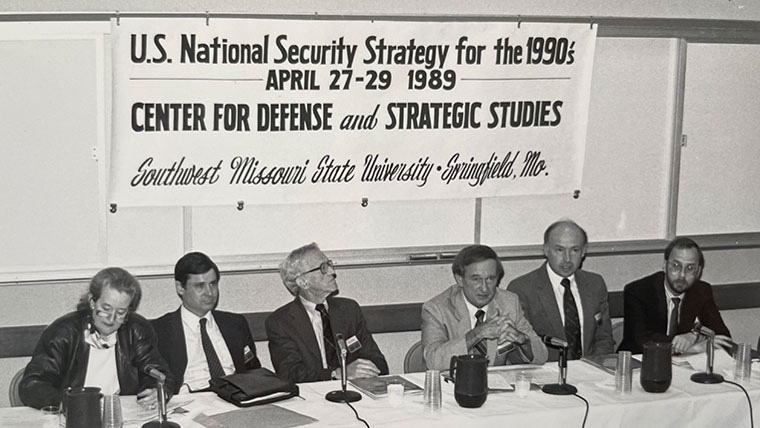
The School of Defense and Strategic Studies (DSS) at Missouri State University has a lineage dating back to the early 1970s, when Professor William Van Cleave established a program in Defense and Strategic Studies at the University of Southern California (USC).
Van Cleave, a Marine who had served in Vietnam and who would go on to be an arms control advisor to the Nixon Administration and head of the Defense Department transition team for President-elect Ronald Reagan–saw a pressing need for an academic program that prepared students to be effective scholars and practitioners of national security policy in the harsh realities of a competitive international security environment.
DSS was his answer to this need. Over the ensuing half century, the DSS program and its graduates–a distinctive group of security-focused experts who became known in some circles, not necessarily always fondly but invariably with respect, as “Cleavers”–have become a unique and influential part of the U.S. national security policy community.
Van Cleave was a native of Missouri who eventually decided to return home to Middle America. He brought the DSS program with him from USC to Southwest Missouri State University in 1987, thus beginning an affiliation with what is now Missouri State University that continues to this day. In 2005, with Van Cleave’s retirement, DSS moved to the Washington, DC, area under the directorship of Dr. Keith Payne, a longtime DSS professor, noted nuclear deterrence theorist, and former U.S. Deputy Assistant Secretary of Defense. Despite these relocations, however, the distinctive “Cleaver” legacy and spirit of the program has not faltered.
Today, DSS enjoys the status of a School within Missouri State's Reynolds College of Arts, Social Sciences and Humanities (RCASH). It has a thriving and growing body of several hundred students across its various programs, which now consist of multiple graduate certificates, two master’s degree programs and a professional doctorate. A PhD program is also expected soon. In 2020, Payne was succeeded by Dr. John Rose, a retired U.S. Army brigadier general and the former head of the George C. Marshall European Center for Security Studies. Dr. Christopher Ford–a former Rhodes Scholar, Assistant Secretary of State, and National Security Council senior director–succeeded Rose in 2026.
DSS is well known for the deep expertise of its faculty, not merely as academics and educators, but also as high-level practitioners of national security policy. It is also known for the flexibility of the broad range of educational opportunities it provides, not just to full-time students, but also to working professionals in the armed services, civil servants, Foreign Service officers, intelligence practitioners, Congressional staffers and think tank staff. Offering the possibility for students living or deployed anywhere in the world to learn from outstanding national scholar-practitioners both “virtually” via evening classes on Zoom and through asynchronous online classes–and yet charging only Missouri rates–DSS continues to be, as it has always been, an outstanding choice for a first-rate national security education like no other.